

Centuries of human exceptionalism have conditioned us to believe we’re separate from nature - at the great cost of the ecological and climate crises we find ourselves in now - when, in fact, we are all part of nature. In this month’s Dreaming Awake, I reflect on what I learned about living as one with nature from an order of mystic monks & how a pilgrimage to some of my favourite wild beaches reminded me how I am part wind, rock, star fish and sea.
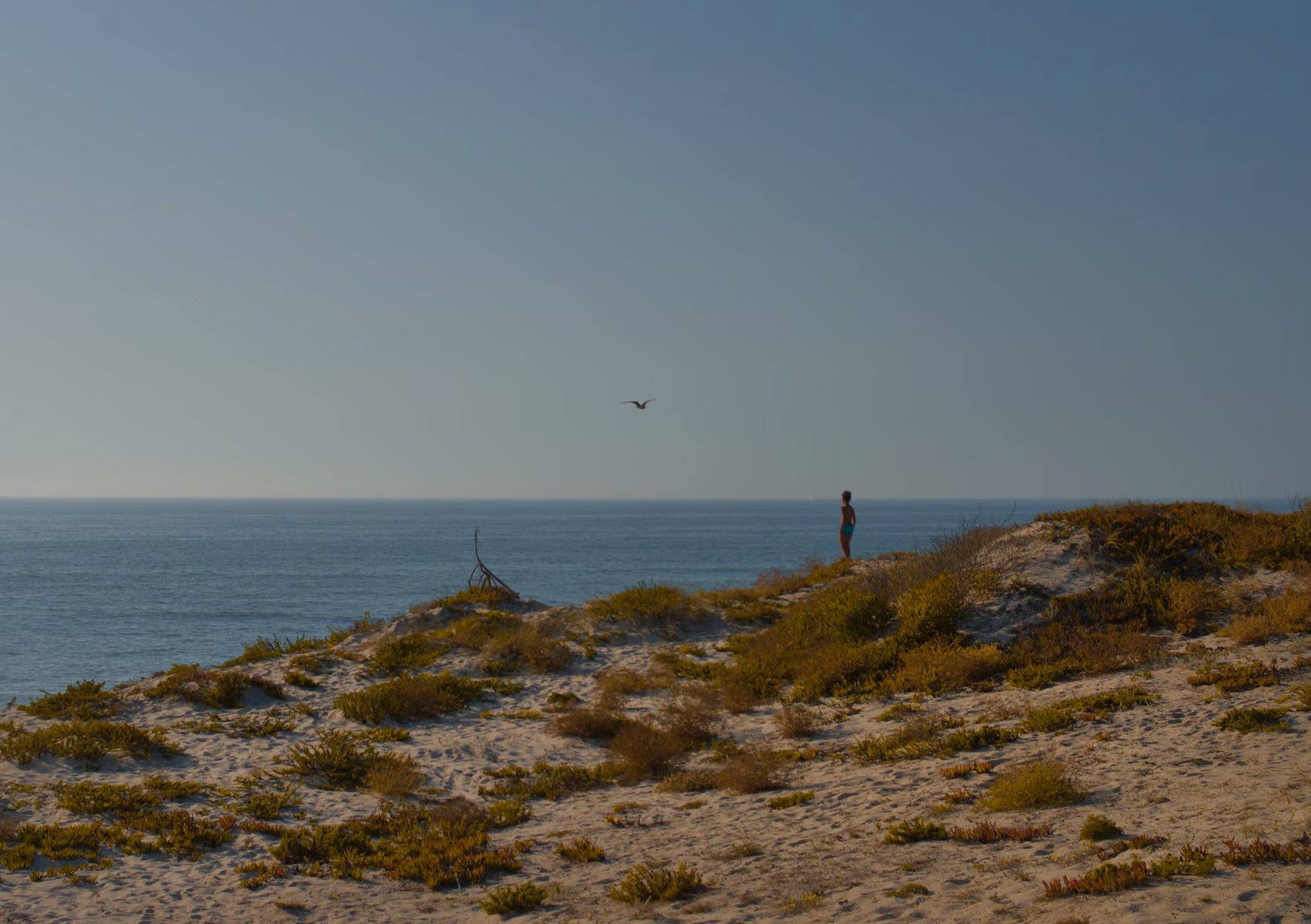
Image: Sérgio Oliveira
Buried in nature
The forest path leading to the 16th century Conventos dos Capuchos, or monastery of the hooded monks, high in the hills of Portugal’s Sintra national park is thick with mist. Far below, hidden behind a dripping curtain of maritime pine and ancient oak, is the Atlantic coast. The song of a blackbird fills the air as I cross a small cloister of plane trees and enter the conventos through a low arched door. I glance up to see, sunk in the plaster above the porch, a skull and cross bones - a reminder to all those who once crossed this threshold of the forfeit required on entrance.
Although the conventos was built according to the ancient idea of a universal, harmonious order in which humans, nature and cosmos are all cut from the same cloth it, nonetheless, feels like a maze. I soon find myself separated from my husband, lost inside its mycelial network of corridors, chapels and cells spread across two floors, branching with small, low-ceilinged rooms. As I crawl through the low doors into the tiny cells where the monks would meditate for hours alone in the dark, it feels less like I’m stepping back in time and more like I’ve slipped its tether altogether and entered a place beyond where the air is thick with something other than mist.
By the time I’ve wended my way through the conventos and out the other side, the clouds have descended to earth in a storm of wild sun-eating gods. Within seconds of leaving the porch, I’m soaked. But instead of doing the sensible thing and going back inside, something calls me up the stream that was a path only an hour earlier, towards the cave at the top where a hermit once lived. I squelch up the hill into the driving wind as it whips the tresses of epiphytes and ferns dressing the trees and the rain turns the hems of my trousers black.
At the dark mossy mouth of the cave, I stop, stunned in my tracks by the emerald green aura lighting up the woods as a loud clap of thunder rolls down the hill like a loosed boulder.
A moment later everything seems to go quiet. Then a deeper darkness falls as the rain intensifies, devouring what’s left of the trees and, even though no one else is around, I get the strangest feeling I’m not alone.
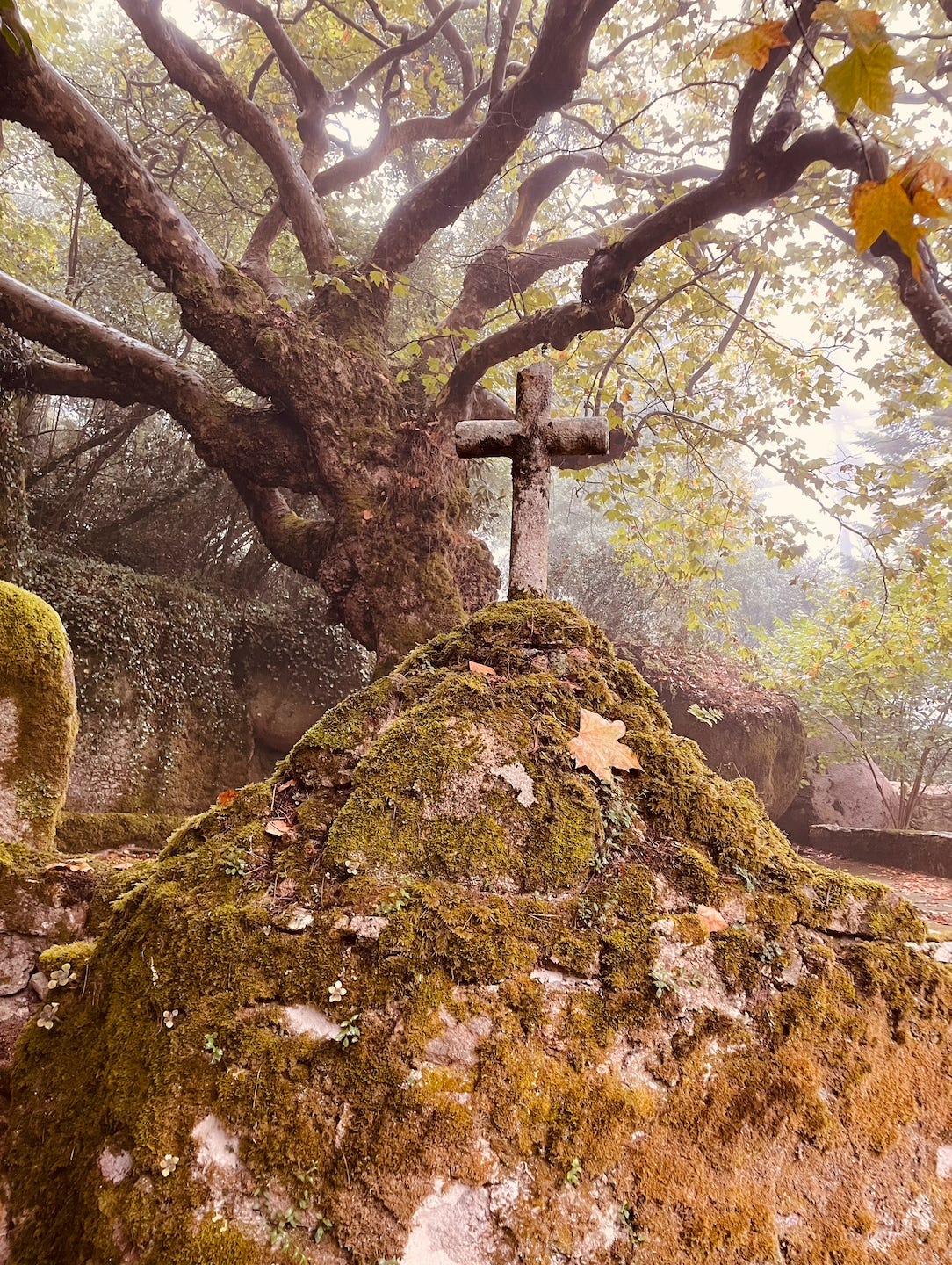
Conventos dos Capuchos, August 2026.
The monk who preached to trees
The generations of mystics who once lived here for over two hundred years belonged to an order of monks founded in the late 12th century by the medieval friar, St Francis. From the beginning, Francis saw the woods and mountains of the Tuscan Apennines where he lived as his cathedral. He would regularly preach to the trees, lambs, rabbits, pigs, bees, falcons and larks - thanking them for making him so happy, famously negotiating a peace deal with a wolf who’d been terrorising a local town that ended in a deep, mutual friendship between the two.
Francis celebrated his love of nature with hymns of praise, in which he addressed the sun, air, water and wind as his brothers and sisters and the earth as his mother “who nourishes us and sustains us, bringing forth fruits and vegetables and flowers of many colours.” A radical of his time, the cosmic interconnectedness embodied by Francis feels no less transgressive now in a world wedded to the idea that somehow we are above nature than it did back then.
Centuries later, Carl Jung arrived at a similar conclusion. Through his deep study of the unconscious and his lifelong search for meaning, Jung held that, at bottom, nature is the deepest, most authentic expression of who we are. He writes in Modern Man in Search of a Soul;
“The psychic depths are nature, and nature is creative life” - Carl Jung
Living in accordance with this deep truth, the hooded monks of the conventos spent their lives buried in nature. What voices, I wonder, did these men of the earth hear in the wind as they sat alone in the dark wombs of their cells sinking deeper and deeper into the mystery of our ancient beginnings? Who spoke to them in the thunder? What speech did they hear in the leaves of the trees?
The cathedral of the beach
A week or so after our trip to the conventos, my husband and I make what has become an annual pilgrimage to a remote part of South-West Portugal where a shifting slip of half-moon coves banked by fluttering stands of wild fennel, eucalyptus and figs dance between the weathered cliffs slouching unhurriedly towards the shore and the luminous blue mosaic of the North Atlantic, beyond.
There’s a lot to be said for developing a relationship with a place over time. It’s been twelve years since we first started coming to this wild and beautiful corner of the planet.
The first glimpse of the ocean as we round the bend of the dusty one-track road scored into hills is like meeting the sapphire smile of a 300-million-year-old guide.
Although only separated by a thin ligament of land dotted with juniper and ruby-berried mastic, each beach is holy in its own way. Each has its own littoral liturgy of tides and winds, surf and waves, clouds and rocks, flora and fauna.
Zavial is the windiest of these beaches. On early morning walks along the shore before the surfers arrive, the breeze swirls into my lungs in the same way the Ribeira dos Outeiros - or river of the hillocks - rushes into the mouth of the ocean, filling me up with the sharp, salty blasts of its north-westerly currents.
On Furnas, the wind and sea have sculpted a crypt-like network of caves into the limestone cliffs from which the beach derives its name. In the hottest part of the day, I crawl into these inner sanctums forged from the skeletal remains of fossilised crustaceans, corals and planktons, ground to smithereens in the teeth of the ocean and reborn as rock. The cool air sends shivers up and down my bare arms as I kneel on the sand inside and I can almost hear the cave breathe, as if I’ve snuck beneath the craggy underbelly of some primordial beast perpetually staggering towards the ocean’s edge.
On Figueira, named for the fig trees that grow along the path to the beach - sea daffodils the pale, translucent colour of whey fill the dunes with the scent of warm, runny honey. It was here last year that the ocean delivered a pod of leaping bottlenose dolphins, only metres from the shore. This year, I find a spiny starfish missing one of its arms curling the magenta-tips of its remaining limbs in the sand at my feet, a dying flower closing its petals against the withering heat. If this brainless, bloodless, pearly queen of the sea makes it back into the depths, her in-built capacity for self-repair means she will grow a new limb. But if left out of water for too long, she will almost certainly become de-hydrated and die. So I gently scoop the star fish into my beach throw and float her small stiff body back into the shallows - bowing as I do to this ancient marine ancestor everything she knows about surviving the depths.
Although I arrive at these beaches with a headful of voices competing to win in a prize for making life all about me, the ever present roar of the ocean thundering through my bones with all the magnificence of a cathedral organ soon drowns them out with its tremulous reminder of how I was once sea daffodil, star fish, wind, rock.
Then, on the last day of our pilgrimage, when the ocean is an overflowing baptism font spilling and splashing onto the shore, I hurl myself into its joyous jade breakers, whirling like spindrift inside their foamy cocoon until, briefly, I’m sea.
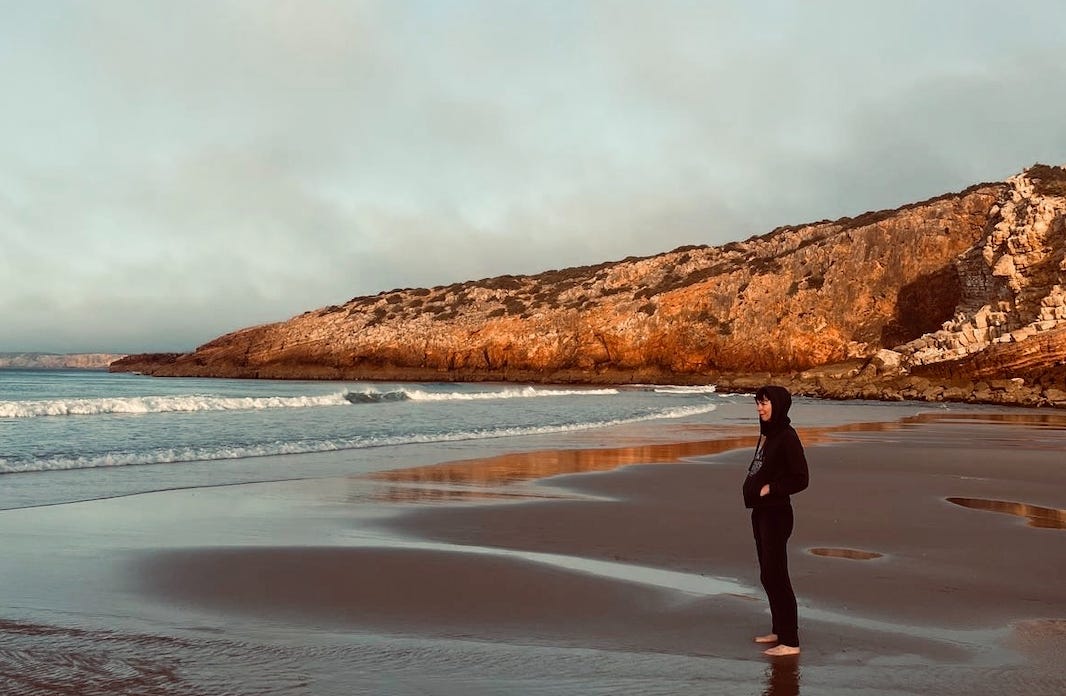
Praia do Zavial, September 2026.
Thank you for reading. If you enjoyed this dispatch do ‘heart’ & share.
Autumn workshops & courses
Autumn depth writing workshop, October 18th & 26th
Explore the seasons & cycles of your self-experience and expand your sense of possibility with writing & imagination via the symbolism of Autumn.
Online participants receive a recording after the event.
Hebden Bridge - Sunday October 18th, 1.30-4.30pm Book Hebden workshop.
Online - Monday October 26th, 6-8pm GMT Book online workshop.
Write Your Undiscovered Self, 5 week online course, 28/10 - 25/11.
Discover the pioneering ideas of Carl Jung & nurture depth of connection with your deep creative self.
It wouldn’t be an understatement to say that an encounter with Jungian therapy changed the course of my life and led me to undertake a PhD exploring the connection between the connection between Jung’s pioneering work into the nature of the unconscious and creative writing. In this course I share an introduction to key Jungian concepts alongside practical, guided exercises focused on how you can use writing as a tool to tap into your unconscious and support your innate creativity.
Over the five weeks you’ll have an opportunity to encounter the creative unconscious through an introductory exploration of your joyful child self, your wise great self and the hidden emotions behind your shadow self with a view to exploring the lessons of each while imagining an expanded, grounded ‘future self’. Weekly worksheets and recordings will be available. Book here.
Subscribe to rachelnewsome.co.uk & stay up to date.
Dreaming Awake is primarily where I ‘explain by doing’ - as the Dodo said to Alice - through sharing my writing. The best way to stay up to date about Jungian-inspired depth writing courses, workshops & retreats is to subscribe to my website newsletter here ~ rachelnewsome.co.uk
I absolutely loved this exploration as we know this very particular place very well too. We’ve been going to Salema for about the same amount of years and have explored the places you describe so beautifully here 💙we didn’t get there in September like we were meant to, so thank you for bringing this alive in me again today, just what I needed 🙏🌊xx
And bobs yer uncle.